
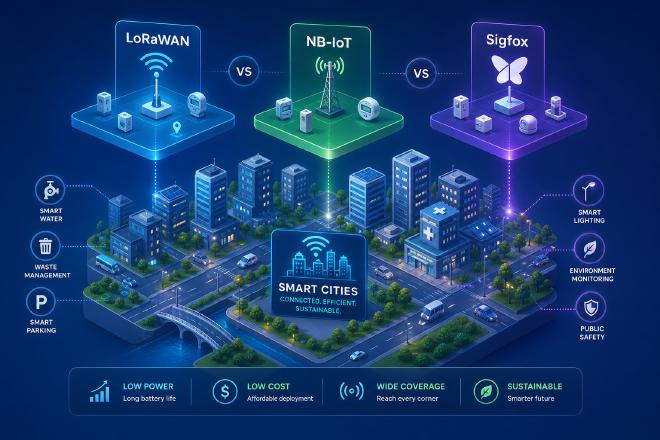
Meta description: Which LPWAN technology is best for smart city applications? Compare LoRaWAN, NB-IoT, Sigfox & LTE-M on cost, coverage, and control, then pick the right one.
Deciding which LPWAN technology is best for smart city applications is one of the highest-stakes procurement calls a municipal IoT team will make. Pick wrong and you don’t just waste a budget. You lock public infrastructure into a network architecture that may not serve its sensors for the next decade. At Kudzu Canopy NOC, we monitor LoRaWAN networks running across real cities every day, and the technology decision made upstream shapes every operational challenge that follows downstream. That pattern holds whether you’re managing 500 parking sensors or 50,000 water meters.
The four main contenders, LoRaWAN, NB-IoT, Sigfox, and LTE-M, are genuinely different tools built for different jobs. They’re not interchangeable wireless options with minor spec differences. Each one makes specific trade-offs across coverage, payload size, power consumption, deployment ownership, and total cost. This article walks through those trade-offs in terms city planners and municipal IoT teams actually care about, then closes with a framework for selecting or piloting the right LPWAN technology before committing at full scale.
How LoRaWAN, NB-IoT, Sigfox, and LTE-M Actually Differ#
Dense urban environments stress every LPWAN technology in a specific way. Concrete buildings absorb signal, device density creates interference, and low-power requirements mean you can’t simply increase transmit power to compensate. The specs that matter aren’t just headline numbers, they’re the practical limits your sensors will live inside for years.
Coverage and Signal Reach in Dense Urban Environments#
LoRaWAN achieves roughly 2, 5 km in urban environments, which typically means four to eight gateways to cover a mid-size city district, depending on building density and terrain. NB-IoT pushes closer to 5 km of urban coverage and benefits from licensed cellular infrastructure’s superior site placement. Sigfox’s often-cited 10 km range sounds impressive, but it comes bundled with a 12-byte uplink payload and near-zero reconfigurability. That trade-off makes sense for ultra-simple sensors and very little else. LTE-M coverage is operator-dependent but generally strong in major US metro areas, where AT&T, T-Mobile, and Verizon all maintain LTE-M presence across most major cities as of 2026.
Power Consumption and Device Battery Life Expectations#
LoRaWAN devices running at low duty cycles routinely achieve 5, 10+ years of battery life, which is adequate for most fixed city sensors. NB-IoT and Sigfox both hit 10+ years under appropriate conditions, and LTE-M reaches 10, 15+ years with PSM and eDRX power-saving modes enabled. These differences matter more for some sensors than others. A buried water meter that’s physically inaccessible for eight years needs to outlast its battery. A streetlight controller mounted at five meters is much easier to service, so battery longevity is a lower priority than capability and response time.
Payload Size and Throughput Limits That Shape Use Case Fit#
LoRaWAN supports 11, 242 bytes per message depending on region and spreading factor. NB-IoT allows up to 1,280 bytes, which creates room to grow a sensor’s data fields over time. Sigfox’s hard 12-byte uplink cap is the most consequential constraint in this comparison: a sensor transmitting temperature, humidity, CO2, and particulate matter simultaneously will exhaust that limit immediately. LTE-M’s higher throughput opens the door to firmware updates and richer telemetry, but at a power and module cost premium that isn’t justified for simple periodic sensing.
Which LPWAN Technology Is Best for Smart City Applications When Cost Is the Deciding Factor#
Cost differences between LPWAN technologies are easy to dismiss at small scale and impossible to ignore at city scale. A 10,000-sensor deployment is where the private versus operator-managed trade-off becomes a real budget conversation with a multi-year horizon. The sections below break down where each technology wins and loses across CAPEX, per-device OPEX, and long-term total cost of ownership.
Infrastructure CAPEX for Private vs. Operator-Managed Networks#
Private LoRaWAN requires upfront gateway and backhaul investment. Operator-managed NB-IoT, LTE-M, and Sigfox offload that infrastructure cost to the carrier, which makes them attractive in the short term. The catch is that this also shifts negotiating power entirely to the carrier for the duration of the contract. A city that owns its LoRaWAN gateways controls its own network expansion, gateway placement decisions, and data routing, none of which holds under a carrier-managed model.
Per-Device Recurring Costs That Compound at City Scale#
NB-IoT typically costs $1, 5 per device per year in connectivity fees. Sigfox subscriptions run at a comparable or higher rate depending on the regional operator. For 10,000 sensors over five years, even a conservative $2/device/year figure compounds to $100,000 in connectivity OPEX, and that’s before accounting for any price increases over the contract term. The one-time gateway infrastructure cost for a comparable private LoRaWAN network typically falls well below that five-year OPEX figure at this scale.
Where Private LoRaWAN Wins on Total Cost of Ownership#
At 10,000+ nodes, private LoRaWAN’s near-zero per-device OPEX produces the lowest total cost of ownership at scale. Independent 7-year TCO models show LoRaWAN running 30, 70% cheaper than NB-IoT at this device count, with the gap driven almost entirely by eliminated subscription fees. This is why most municipal smart city programs default to LoRaWAN once they model the 5-year numbers. The gateway investment pays for itself through subscription savings within the first few years, and everything after that is pure OPEX savings.
Matching Each LPWAN Technology to Real Municipal Use Cases#
Specs in isolation don’t make deployment decisions. The real question is which LPWAN technology is best for smart city applications in each specific use case that city planners are actually running. The three categories below cover the majority of municipal sensor programs currently in operation.
Parking Sensors and Smart Water Metering#
LoRaWAN’s combination of small payloads, deep indoor and underground penetration, and no per-device subscription fees makes it the natural fit for parking sensors and buried water meters. The Santander smart parking deployment and Calgary’s city-wide LoRaWAN network for water management are both well-documented examples of this fit working at operational scale. NB-IoT is a viable alternative for water meters in areas with strong cellular infrastructure but limited LoRaWAN gateway coverage, particularly in dense urban cores where cellular signal penetrates below grade effectively.
Air Quality Monitoring and Environmental Sensing#
Environmental monitoring sensors need frequent readings but small payloads, which fits LoRaWAN’s duty-cycle model cleanly. The LoRa Alliance’s smart cities technical documentation explicitly supports air pollution, environmental, and weather station monitoring as proven LoRaWAN applications. Sigfox’s 12-byte uplink constraint creates a real problem here: a sensor reporting temperature, humidity, CO2, and particulate matter in a single message will exceed that limit. Cities that want to expand a sensor’s reporting fields later need the payload headroom that LoRaWAN and NB-IoT provide.
Waste Management and Street Lighting Control#
Amsterdam’s smart city waste management deployment is a frequently cited LPWAN use case, using sensor networks for route optimization and bin-fill monitoring. Simple occupancy-driven waste sensors are well-served by LoRaWAN’s economics: small payload, infrequent transmission, no subscription cost. Street lighting controllers are a different calculation. When two-way control, dimming schedules, and firmware updates are required, LTE-M’s lower latency and larger payload capacity become genuine advantages for that specific use case. Barcelona’s lighting control program demonstrates the value of responsive control at city scale, and LTE-M is better positioned for that application than LoRaWAN.
Security Posture, OTA Updates, and Ecosystem Readiness#
Municipal deployments face a higher accountability standard than private enterprise networks. Public infrastructure means public scrutiny, and city procurement teams need to understand what’s built into each technology, and what isn’t.
Built-In Security and Authentication Across the Four Technologies#
LoRaWAN uses AES-128 session keys at two layers: the Network Session Key protects communication integrity with the network, and the Application Session Key protects payload confidentiality between device and application server. NB-IoT and LTE-M inherit cellular security models with SIM/eSIM-based authentication and operator-managed trust infrastructure. Sigfox relies more heavily on application-layer controls rather than deep protocol-level security. Across all four technologies, municipal security depends on correct key management, certificate validation, and backend integration hardening. For an accessible overview of IoT security considerations specific to LoRaWAN and LPWAN deployments, see IoT security for LoRaWAN and LPWAN.
OTA Firmware Update Practicality for City-Managed Sensor Fleets#
LTE-M and NB-IoT handle large OTA packages more effectively than LoRaWAN due to higher throughput and more flexible session continuity. LoRaWAN OTA is possible but requires carefully engineered fragmentation, signed firmware manifests, broadcast-based chunk distribution for large fleets, and rollback protection in case a failed update leaves a device offline in a hard-to-reach location. For a practical primer on OTA workflows, see How does an OTA firmware update work and for LoRa-specific fragmentation techniques see Firmware updates over LPWAN (LoRa). Sigfox is largely impractical for regular firmware patching and generally requires a separate maintenance channel for anything beyond trivial updates. Municipal procurement specs should require signed firmware, rollback protection, and lifecycle key revocation regardless of which LPWAN is selected.
Operator Availability and Network Coverage Gaps in the US#
LTE-M has the strongest domestic carrier presence in the US in 2026, with broad metro-area coverage across most major cities. NB-IoT availability is more limited and uneven; US carriers invested more heavily in LTE-M, and the industry trend is moving toward 5G RedCap rather than expanding NB-IoT. Sigfox’s US footprint is the most constrained of the three: operator-managed, regionally inconsistent, and not expanding. This landscape often pushes US cities toward private LoRaWAN, which eliminates carrier dependency entirely, or toward LTE-M for mobile and high-value assets where a cellular carrier relationship is already in place.
A Practical Decision Framework for Municipal Planners#
City planners don’t need a perfect universal answer. They need a clear set of questions that narrow the field quickly for their specific deployment context.
Key Questions to Answer Before Selecting a Technology#
Start here: How large is the deployment? Anything north of 5,000 devices should be modeled for 5-year TCO before a technology is selected. Are the devices static or mobile? Mobile assets need LTE-M. Is carrier dependency acceptable for a decade-long program? What’s the IT staffing reality for managing private infrastructure? Does the city have the operational capability to own and run a LoRaWAN network, or does it need to outsource that function to a carrier? Each answer eliminates one or two options quickly and usually narrows the field to two viable choices.
Running a Pilot the Right Way Before Full-City Rollout#
Deploy 50, 100 sensors across a representative geography before committing to a full rollout. During the pilot, measure Packet Delivery Ratio (PDR), coverage gaps identified through geospatial mapping, battery performance under real environmental conditions, and integration latency to the city’s backend systems. For private LoRaWAN, gateway placement is a one-time infrastructure decision that becomes very expensive to undo at full scale. A pilot that surfaces coverage gaps early is worth far more than the cost of the extra time it takes. For field lessons from a recent conference deployment, see Ensuring a Healthy LoRaWAN Installation: Kudzu’s Success at The Things Conference 2024.
Why LoRaWAN Emerges as the Strongest Fit for Most City Deployments#
For most fixed municipal sensor programs, parking, water, air quality, waste, environmental monitoring, private LoRaWAN combines the lowest long-term total cost of ownership with full network ownership, no carrier dependency, flexible payload configuration, and a mature US ecosystem operating under FCC Part 15 unlicensed rules on the 915 MHz ISM band. LTE-M remains a strong complement for mobile assets, high-value infrastructure, and any use case requiring reliable two-way control. NB-IoT is a reasonable option in specific situations where cellular coverage is strong and gateway infrastructure isn’t feasible.
Technology Selection Is Decision One, Operations Is Decision Two#
To summarize: LoRaWAN wins on cost and control at scale. NB-IoT wins on urban coverage and simpler rollout. LTE-M wins on mobility and OTA update capability. Sigfox is too payload-constrained for most modern municipal use cases, and its US footprint is too limited to depend on for new programs. When evaluating which LPWAN technology is best for smart city applications, most fixed sensor programs, parking, water, air quality, waste, point toward private LoRaWAN as the most defensible long-term choice.
Selecting the right LPWAN technology is decision one. Decision two is managing the network once it’s live, and that’s where many municipal programs underestimate the challenge. Monitoring RF coverage across a city grid, proving SLA compliance to stakeholders, identifying device failures before they become service gaps, and reporting on network health without a dedicated NOC team all require purpose-built tooling. That’s exactly what Kudzu Canopy NOC is built for. Read our analysis, How LoRaWAN Monitoring Platforms Compare for Enterprise Use · Kudzu Canopy NOC : AI-Driven LoRaWAN Network Operations.
Kudzu Canopy NOC gives municipal operators continuous KPI monitoring, geospatial RF coverage visualization, AI-powered alarm triage through Nomi, and automated Certificate of Nominal Operation reporting, everything needed to run a city-scale LoRaWAN deployment professionally without building out a large internal operations team. If you’re planning a municipal LoRaWAN program or already operating one, start a conversation with the Kudzu Canopy NOC team to see how purpose-built network operations changes what’s possible.