
When we joined the 16th AI Connected World 2026, the title of the event already suggested the direction of the discussion: Connect, Protect, Innovate.
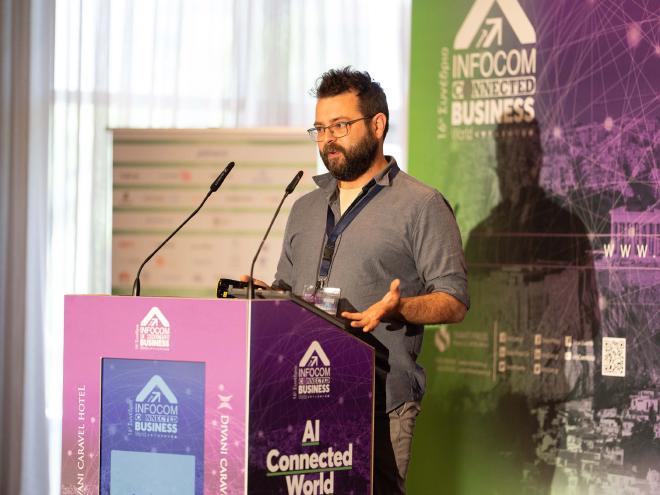
But what became clearer throughout the day was something broader. AI is no longer being discussed only as a layer of digital applications, automation tools or productivity assistants. It is increasingly entering the operational layer of infrastructure: how systems are connected, protected, monitored, maintained and improved over time.
For Kudzu Technologies, this was a particularly relevant conversation. Our work has always been close to the physical side of digital transformation: networks, IoT infrastructure, field deployments, smart cities and the operational reality that comes after a system goes live.
AI is becoming operational#
One of the strongest impressions from the conference was that AI is moving closer to the systems that businesses and public organizations depend on every day.
The discussion was not limited to abstract AI potential. It touched cybersecurity, mobility, finance, energy, telecommunications, customer experience, software development and digital government. In all these areas, the question is no longer simply how AI can automate a task. The question is how AI can help organizations operate more complex systems with more speed, more context and more confidence.
This is an important shift.
Digital transformation used to be about putting services online. Then it became about connecting systems and collecting data. The next step is making those systems operationally intelligent.
Infrastructure now means connectivity, security and resilience together#
Another clear theme was that infrastructure can no longer be discussed only in terms of connectivity.
A connected system that is not secure is fragile. A secure system that cannot adapt is slow. A smart system that cannot be operated reliably over time becomes a liability.
This is where the conference theme felt especially relevant. Connect, Protect, Innovate is not just a slogan. It describes the new reality of digital infrastructure. Networks, platforms, data centers, public services and business systems are becoming interdependent. Their value depends not only on whether they are deployed, but on whether they remain resilient, understandable and operational under real conditions.
Smart cities are becoming an operations challenge#
The smart city discussion made this particularly tangible.
Cities are not short of ideas. They have sensors, applications, platforms, digital services and increasing access to data. The harder question is what happens after deployment.
Who operates these systems? Who understands when something is not working? How do different departments, suppliers and technologies coordinate? How does a municipality know that a digital service continues to deliver value after the first installation?
This is where smart cities move from technology projects to operational infrastructure. The future of smart cities will not be defined only by the number of connected devices or digital applications. It will be defined by the ability to operate those systems reliably, transparently and continuously.
AI is entering everyday business workflows#
At the same time, the conference showed that AI is not only a topic for deep-tech companies or research teams.
In the “Smart Business Tools” section, the discussion moved across private wireless networks, digital transformation, customer experience, AI search, software development, financial workflows and large-scale network operations. Different fields, different companies, different use cases but a common direction.
AI is becoming part of how businesses work.
Not as a separate experiment, but as a layer that can support decisions, speed up processes, expose hidden patterns and help teams act with better context.
Our contribution to the discussion#
In this context, Kudzu presented the question:
How can AI change the way large-scale networks are operated?
Our answer starts from a simple observation: once networks become part of critical services, visibility is not enough.
Operators do not only need to see that something happened. They need to understand why it happened, what it affects, what should be done next and whether the action actually improved the system.
This is the direction we are taking with Canopy NOC: moving from dashboards toward intelligent network operations for large-scale IoT and LoRaWAN infrastructure.
From connected systems to intelligent operations#
If there is one thought we took away from AI Connected World 2026, it is this:
The next phase of AI will not be judged only by how impressive the applications look. It will be judged by how much better it helps us operate the systems we already depend on.
For businesses, cities and infrastructure operators, that shift is only beginning.